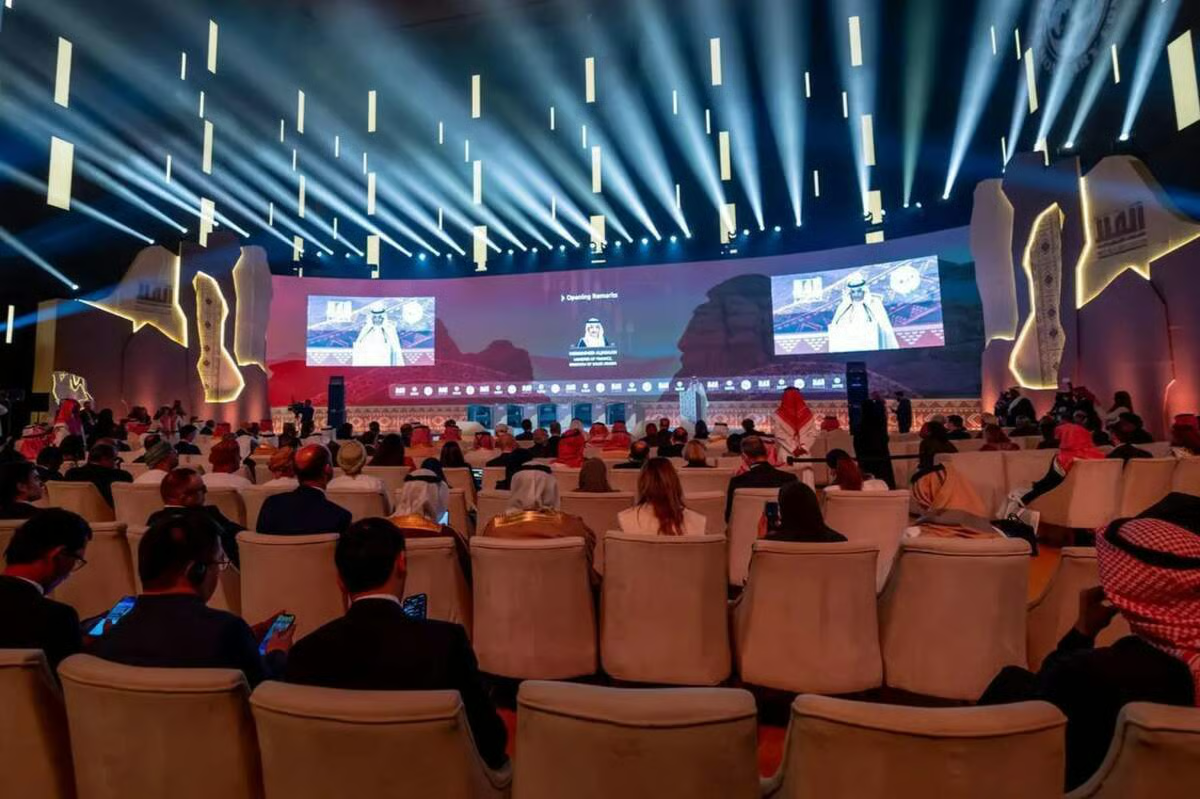


DUBAI, United Arab Emirates, January 7, 2026 (EZ Newswire) — Global prime broker EXANTE has released its latest research report, “From the Abraham Accords to AI to FTAs: How to Trade the New Middle East,” unveiling a view of how the GCC is rapidly emerging as one of the world’s most strategically important investment regions. The report was launched during an exclusive investor briefing held with CME Group at the prestigious Capital Club in Dubai.
The report argues that 2025 marks a structural inflection point for the Gulf, driven by the convergence of AI acceleration, shifting trade alliances, energy-transition investment, and an increasingly multi-aligned geopolitical strategy.
“The Middle East is no longer merely reacting to global change — it is driving it,” said Dr. Renée Friedman, global head of research at EXANTE. “AI infrastructure, new free-trade agreements, and the economic dividends of the Abraham Accords are not isolated trends — together they are rewriting the region’s investment landscape. Those who map these linkages early will have a clear advantage.”
Key Findings From the Report
- AI is becoming the region’s next economic engine. Massive capital flows into data centres, cloud capacity and next-generation digital infrastructure are positioning the UAE and Saudi Arabia as global AI power hubs, leap-frogging legacy systems found elsewhere.
- FTAs are reshaping the region’s global footprint. The UAE’s more than 25 CEPAs — and the GCC’s widening trade network — are embedding the region deeper into global value chains, boosting resilience and unlocking new markets for non-oil sectors.
- The Abraham Accords are delivering sustained economic dividends. Bilateral trade between Israel and the UAE continues to grow, underpinned by tech collaboration, investment flows and shared innovation priorities — creating a durable new economic corridor.
- The energy transition is redefining long-term growth. With oil’s share of GDP slowly declining, Gulf states are investing heavily in renewable energy, green hydrogen, carbon-capture technology and critical minerals — securing relevance in the global decarbonisation cycle.
- GCC macro fundamentals remain exceptionally strong. Despite monetary-policy divergence, global debt stress and tariff volatility, the region continues to post low inflation, healthy current-account balances and relatively robust sovereign wealth buffers.
- New geopolitical alignments are giving the region more strategic autonomy. Multi-aligned diplomacy — balancing the U.S., China, BRICS, and emerging Asian partners — is enabling Gulf states to secure trade deals, capital flows and technology partnerships on their own terms.
The report concludes that the Middle East now represents one of the most compelling investment frontiers of the decade, offering opportunities across digital infrastructure, renewable energy, logistics, healthcare, financial services and advanced manufacturing — but emphasizes the need for timely and sophisticated analysis to navigate fast-moving risks.
To learn more, please refer to the original article, click here.
————
Disclaimer: The content of the above information is sourced (or provided), in entirety or in parts from an external source and the content may or may not be edited. The Wealth Today shall not be held liable for damages arising out of any action taken with respect to the use or consumption of information or service published above or anywhere else on the website. This website does not guarantee the accuracy, views, opinions, or any promises expressed in the above news. If you find any errors or discrepancies in the above information, you can write to us at editor@thewealth.today.