



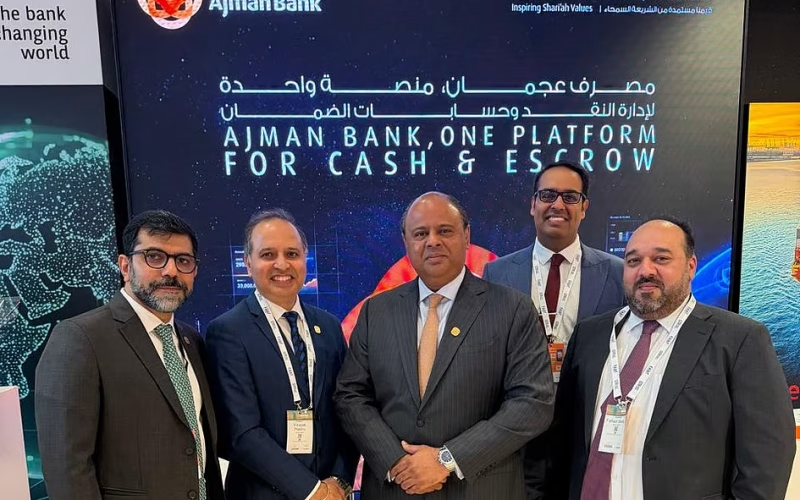
Ajman Bank participated in the GTR MENA 2026 conference, which was held on February 10 and 11 at the Emirates Towers Jumeirah – Dubai, with the attendance of a select group of executive leaders and decision-makers from banks, financial institutions, companies and government entities operating in the trade finance, export and infrastructure sectors.
This conference is a leading regional platform for specialized dialogue on trade finance, bringing together various stakeholders to discuss developments in global trade flows, risk management frameworks, regulatory updates, and the growing role of financial institutions in supporting cross-border trade.
Ajman Bank’s participation in the conference underscored its ongoing commitment to engaging with specialized platforms that foster institutional collaboration, knowledge sharing, and the adoption of best practices in trade finance and structured finance markets. Through its participation, the bank exchanged insights with its partners and peers on the latest market developments and emerging investment and trade opportunities. The role of Sharia-compliant banking solutions in supporting trade and boosting economic activity in the region was also discussed.
As part of the conference agenda, Dr. Fadl Rahim Abdul, Head of Internal Sharia Compliance and Secretary of the Sharia Supervisory Board at Ajman Bank, participated in a panel discussion on the role of innovation in expanding the scope of Islamic trade finance. The session reviewed the projected growth of the GCC trade finance market, currently valued at approximately US$185 billion and expected to reach US$290 billion by 2030, with a particular focus on the rapid expansion of Sharia-compliant finance across cross-border trade corridors, especially in Southeast Asia and Africa.
The session also addressed the evolution of compliance frameworks, advancements in Know Your Customer (KYC) procedures and systems, and sanctions monitoring. It further explored the growing role of non-bank financial institutions in supporting small and medium-sized enterprises (SMEs), as well as the increasing integration of Islamic finance principles with sustainability goals in developing green trade finance solutions. The session also examined the role of artificial intelligence and advanced analytics in enhancing risk assessment efficiency, raising governance standards, and supporting financial inclusion within Islamic finance ecosystems.
In this context, Ashish Madan, Head of Global Transaction Banking, said: “Islamic trade finance continues to evolve as a structured and flexible financing model. When innovation is combined with sound Sharia governance and strong risk management frameworks, it enhances transparency, increases the efficiency of cross-border operations, and supports sustainable economic activity. As trade corridors widen, institutions must balance growth and governance to maintain trust and promote long-term stability.”
Ajman Bank continues to strengthen its presence in regional and international financial markets through active participation in leading specialized forums, confirming its commitment to disciplined growth, good governance, and creating long-term sustainable value.
To learn more, click here.
————
Disclaimer: The content of the above information is sourced (or provided), in entirety or in parts from an external source and the content may or may not be edited. The Wealth Today shall not be held liable for damages arising out of any action taken with respect to the use or consumption of information or service published above or anywhere else on the website. This website does not guarantee the accuracy, views, opinions, or any promises expressed in the above news. If you find any errors or discrepancies in the above information, you can write to us at editor@thewealth.today.